
QR codes have evolved beyond simple black and white squares. Today, businesses and individuals can choose between two main types: static and dynamic QR codes. Understanding their differences is crucial for making the right choice for your specific needs.
Let’s explore the key distinctions, advantages, and ideal use cases for each type.
🎯 Quick Comparison: Static vs Dynamic QR Codes
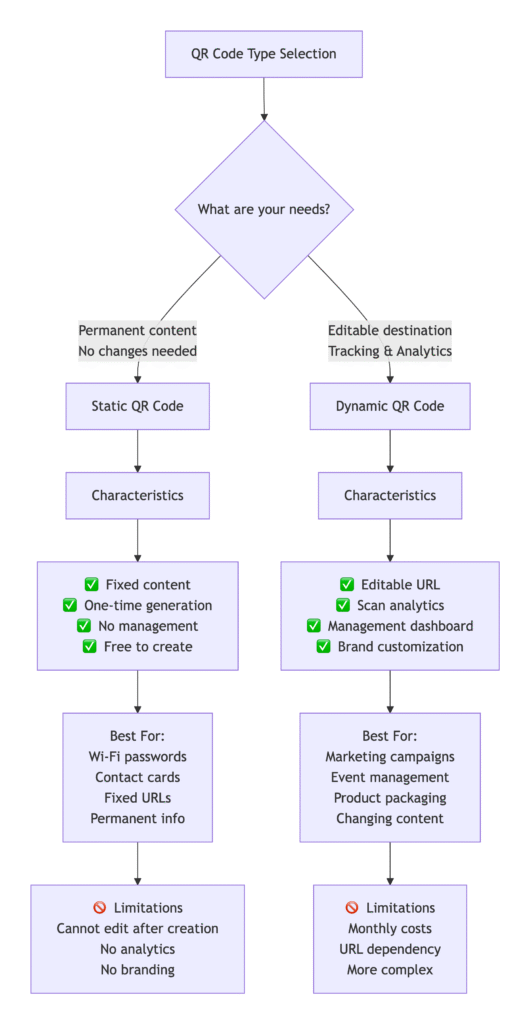
📋 What is a Static QR Code?
Definition:
A static QR code contains fixed, unchangeable information that is directly encoded into the pattern itself. Once generated, the content cannot be modified without creating a new QR code.
Key Characteristics:
- 🔒 Permanent content – Data is embedded directly in the code
- 🆓 Free to create – No ongoing costs
- 📱 Offline functionality – Works without internet connection
- 🔄 One-time generation – Cannot be edited after creation
- 📊 No analytics – Cannot track scans or user data
Technical Structure:
Static QR Code → Direct Data Encoding → Fixed Content
🔄 What is a Dynamic QR Code?
Definition:
A dynamic QR code contains a short URL that redirects to your actual content. The destination URL can be changed anytime without altering the QR code itself.
Key Characteristics:
- ✏️ Editable destination – Change content without changing the code
- 📈 Analytics & tracking – Monitor scans, locations, devices
- 🎨 Brand customization – Colors, logos, frames
- 💰 Subscription-based – Usually requires paid service
- 🌐 Internet-dependent – Requires connection to redirect
Technical Structure:
Dynamic QR Code → Short URL → Your Content (Editable)
                        ↓
               Analytics Dashboard
📊 Detailed Feature Comparison
| Feature | Static QR Code | Dynamic QR Code |
|---|---|---|
| Content Editing | ❌ Not possible | ✅ Fully editable |
| Analytics | ❌ No tracking | ✅ Detailed analytics |
| Cost | ✅ Free | 💰 Paid subscription |
| Branding | ❌ Limited | ✅ Full customization |
| Scan Limits | ✅ Unlimited | ⚠️ May have limits |
| Internet Required | ✅ No | ✅ Yes for redirection |
| Creation Speed | ✅ Instant | ⚠️ Setup required |
| Long-term Use | ✅ Excellent | ✅ Excellent |
| Campaign Use | ❌ Poor | ✅ Excellent |
🏆 When to Use Static QR Codes
✅ Ideal Use Cases:
1. Permanent Contact Information
- Business cards with vCard information
- Office directory contact details
- Example:
BEGIN:VCARD...encoded directly
2. Wi-Fi Network Access
- Guest Wi-Fi passwords
- Office network access
- Example:
WIFI:S:NetworkName;T:WPA;P:Password;;
3. Fixed URLs
- Link to permanent social media profiles
- Company website homepage
- Example:
https://www.company.com
4. Simple Text Information
- Product serial numbers
- Instructions or disclaimers
- Example:
Product ID: XJ-89234
5. Email Drafts
- Pre-filled email templates
- Customer support addresses
- Example:
mailto:support@company.com?subject=Help
🎯 Advantages for These Use Cases:
- No ongoing costs – Create once, use forever
- Works offline – Essential for printed materials
- Instant access – No redirect delays
- Predictable – Content never changes unexpectedly
🚀 When to Use Dynamic QR Codes
✅ Ideal Use Cases:
1. Marketing Campaigns
- Product launches with changing landing pages
- Seasonal promotions and offers
- Benefit: Update URLs without reprinting materials
2. Event Management
- Conference details that change weekly
- Ticket validation and updates
- Benefit: Track attendance and engagement
3. Restaurant Menus
- Daily specials and price changes
- Seasonal menu updates
- Benefit: No need to reprint QR codes
4. Product Packaging
- Link to video tutorials that may be updated
- Customer support resources
- Benefit: Maintain current information
5. Digital Business Cards
- Contact information that changes
- Multiple profile links
- Benefit: Single QR code for lifetime use
🎯 Advantages for These Use Cases:
- Content flexibility – Adapt to changing needs
- Performance tracking – Measure campaign success
- A/B testing – Compare different landing pages
- Error correction – Fix broken links instantly
💰 Cost Analysis: Static vs Dynamic
Static QR Codes:
- Creation: Free (many online generators)
- Maintenance: $0
- Long-term: No ongoing costs
- Tools: QRCode Monkey, QRickit, Canva
Dynamic QR Codes:
- Basic Plans: $5-$15/month
- Professional: $15-$50/month
- Enterprise: $50-$200+/month
- Tools: Beaconstac, QRCode Chimp, Scanova
ROI Consideration:
Rule of Thumb: If you need analytics or might change content, dynamic QR codes are worth the investment. For permanent information, static codes are more cost-effective.
🔧 Technical Implementation
Creating Static QR Codes:
// Example: Simple QR code generation
const staticData = "https://your-permanent-url.com";
const qrCode = generateQRCode(staticData);
// Output: Fixed image that never changes
Creating Dynamic QR Codes:
// Example: Dynamic QR code structure
const shortUrl = "https://qr.company.com/abc123";
const dynamicQR = generateQRCode(shortUrl);
// The short URL points to editable content in dashboard
Redirection Process:
- User scans dynamic QR code
- Code contains:
https://qr.service.com/xyz789 - Service redirects to:
https://your-actual-content.com - Analytics recorded in real-time
📈 Analytics Capabilities Comparison
Static QR Codes:
- ❌ No scan tracking
- ❌ No geographic data
- ❌ No device information
- ❌ No time-based analysis
Dynamic QR Codes:
- ✅ Total scan count
- ✅ Geographic location data
- ✅ Device type (iOS/Android)
- ✅ Time and date stamps
- ✅ Scan frequency trends
- ✅ Unique vs returning scanners
🛡️ Security Considerations
Static QR Code Security:
- ✅ Pros: Content verified at generation
- ❌ Cons: Cannot update if compromised
- ⚠️ Risks: Permanent if containing sensitive data
Dynamic QR Code Security:
- ✅ Pros: Can disable malicious codes instantly
- ❌ Cons: Dependent on service provider security
- ⚠️ Risks: URL hijacking potential
Best Practices:
- Use HTTPS URLs in both types
- Regular monitoring of dynamic QR analytics
- Avoid encoding sensitive data directly in static codes
- Use password protection for sensitive dynamic content
🔄 Migration Considerations
From Static to Dynamic:
- When: Need analytics or content changes
- Process: Create new dynamic code and replace static one
- Challenge: Updating all printed materials
From Dynamic to Static:
- When: Content is permanently fixed
- Process: Generate static code with final URL
- Benefit: Eliminate ongoing subscription costs
Static vs Dynamic QR Codes FAQ
Your complete guide to understanding the differences and making the right choice
Can I convert a static QR code to dynamic later?
No, you cannot convert an existing static QR code to dynamic. Here’s why and what you can do instead:
🔄 Static QR Code Limitations
- Data is permanently encoded in the pattern
- No backend service for redirection
- Content cannot be modified after creation
- No analytics tracking capability
🚀 Dynamic QR Code Solution
- Create a new dynamic QR code
- Replace all static code instances
- Set up redirect and analytics
- Future-proof your QR strategy
📋 Migration Process:
- Create new dynamic QR code with your preferred service
- Test the dynamic code thoroughly
- Update all digital instances (websites, emails, social media)
- Replace printed materials during next print run
- Monitor both codes during transition period
Are dynamic QR codes worth the cost for small businesses?
It depends on your specific business needs and growth stage. Here’s a detailed breakdown:
Worth the Investment When:
- Marketing campaigns with printed materials
- Product packaging with long shelf life
- Multiple locations needing centralized tracking
- A/B testing landing page performance
- Event management with changing details
Stick with Static When:
- Fixed contact information on business cards
- Wi-Fi access for guests/customers
- Simple website links that won’t change
- One-time events with fixed information
- Very limited budget for digital tools
💡 Budget-Friendly Tips:
- Start with free trials from multiple providers
- Use basic plans ($5-15/month) for essential features
- Combine multiple URLs in one dynamic QR code
- Track ROI by connecting scans to conversions
What kind of analytics do dynamic QR codes provide?
Dynamic QR codes provide comprehensive analytics that can transform your marketing strategy. Here’s what you can track:
Basic Scan Metrics
Geographic Data
Device Insights
Behavioral Analytics
Can I use both types of QR codes in the same campaign?
Absolutely! Using both static and dynamic QR codes strategically can maximize your campaign effectiveness.
🎯 Dynamic QR Codes for Campaign Core
Track engagement and conversion rates
Update content without changing codes
Compare different landing page versions
🔧 Static QR Codes for Supporting Elements
Permanent vCard data on business cards
Fixed network credentials
Permanent links that won’t change
🏪 Restaurant Campaign Example:
Daily specials menu (printed on table tents)
Wi-Fi access (wall signage)
Loyalty program (receipts)
Google Maps location (business cards)
What happens if my dynamic QR code service shuts down?
This is a critical risk to consider with dynamic QR codes. If your service provider shuts down, your QR codes will stop working immediately.
🚨 Immediate Consequences:
- All dynamic QR codes become inactive – Redirects fail
- Printed materials become useless – Costly reprints needed
- Analytics data may be lost – Historical insights gone
- Customer trust damaged – Broken links frustrate users
- Campaign disruption – Marketing efforts halted
🛡️ Risk Mitigation Strategies:
Select services with 5+ years track record and positive reviews
Export analytics monthly to maintain historical data
Some services allow using your own domain for redirects
Know how to quickly switch providers if needed
📝 Emergency Action Plan:
- Immediately create new dynamic QR codes with alternative provider
- Update all digital instances (website, email signatures, social media)
- Create temporary landing page explaining the change
- Plan phased replacement of printed materials
- Communicate changes to affected stakeholders
🎯 Decision Framework: Which Should You Choose?
Ask Yourself These Questions:
- “Will I need to change the content later?”
- Yes → Dynamic
- No → Static
- “Do I need to track scans and user data?”
- Yes → Dynamic
- No → Static
- “Is this for permanent information?”
- Yes → Static
- No → Dynamic
- “What’s my budget?”
- Limited → Static
- Flexible → Dynamic
- “Will this be printed long-term?”
- Yes → Consider both carefully
- No → Dynamic preferred
✅ Final Recommendations
Choose Static QR Codes When:
- Information is permanent and won’t change
- No tracking or analytics needed
- Budget is limited
- Offline functionality is important
Choose Dynamic QR Codes When:
- Content may need updates
- Analytics and tracking are valuable
- Marketing campaign performance matters
- Budget allows for subscription costs
Hybrid Approach:
Many successful businesses use both types strategically—static for permanent information and dynamic for marketing and changing content.
🚀 Next Steps
- Audit your current QR code needs
- Determine your must-have features
- Set a realistic budget
- Test both types with small projects
- Implement at scale based on results
Remember: The right choice depends entirely on your specific use case, budget, and long-term goals. Choose wisely! 🎯